Dirk Habenschaden and ChatGPT, Oct 7, 2025
What Is AI Art?
AI art (also called artificial intelligence art) refers to artworks that are created or influenced through the use of artificial intelligence. AI models such as artificial neural networks are employed to generate images, music, texts, or other forms of art. In essence, any artwork that is not created directly by a human but instead produced by an AI can be classified as AI art. This AI-generated art includes paintings, musical compositions, poems, or even videos that emerge from algorithmic processes. In many cases, just a few words as a prompt are enough to produce a result. Even though humans influence the outcome by crafting the prompt, the finished work is ultimately attributed to the AI as its creator.
How Is Artificial Intelligence Used in Art — and How Does It Change the Creative Process?
The use of AI in art opens new possibilities for artists. Many artists employ AI tools as creative instruments or partners to expand their practice. Some collaborate with AI as a production tool: for example, artist Sofia Crespo uses neural networks to generate novel visual worlds that merge technology and nature. Similarly, German artist Mario Klingemann works with neural networks as a creative collaborator, exploring new forms of expression. In such cases, the human remains the director, while the AI provides variations and inspiration. Robotics and AI are also integrated into installations — for instance in the work of Patrick Tresset, who uses robotics and AI while critically reflecting on the role of AI art itself.
Overall, AI can help artists generate new ideas, handle routine tasks (such as style transfers or color studies), and overcome creative blocks. It is important to view AI as a tool rather than a threat to one’s own creativity — it does not replace artistic intent but can amplify it. Many creatives therefore see AI as a kind of “artistic muse” or studio assistant. At the same time, the growing use of AI raises questions of authorship and originality, since AI models are typically trained on existing works. This leads to ongoing debates about the value and role of human creation in the age of AI.
Which Milestones and Breakthroughs Mark the Historical Development of AI Art?
The relationship between art and AI has a longer history than one might expect. As early as the 1960s, pioneers experimented with computer art that served as a precursor to today’s AI art. In 1965, the first exhibitions of computer-generated art took place almost simultaneously — in Stuttgart by Georg Nees and Frieder Nake, and in New York by A. Michael Noll and Béla Julesz. These early works were created with programmed code (e.g., ALGOL) and plotter-controlled machines. Soon after, artist Harold Cohen began developing the AI art system AARON in the late 1960s, a program capable of autonomously drawing and painting — a major milestone in early AI art.
True breakthroughs in AI art emerged in the 21st century with modern machine-learning methods. In the 2010s, deep learning enabled increasingly powerful creative AI models. The introduction of Generative Adversarial Networks (GANs) in 2014 was a turning point: this generator-discriminator framework made it possible to synthesize astonishingly realistic images. One well-known example is Google’s DeepDream (2015), which transformed existing images into dream-like artistic visions.
More recent advances (early 2020s) build on developments such as CLIP (Contrastive Language–Image Pre-training) by OpenAI, enabling AI models to execute entirely novel concepts (so-called zero-shot learning, such as generating an image of an “avocado chair” without direct examples). The year 2022 marked a significant shift: OpenAI introduced DALL·E (2021) and DALL·E 2, both capable of generating diverse images from text descriptions. Google presented models such as Imagen (2022), while Stable Diffusion was released in August 2022 as the first major open-source image model. The open-source availability of Stable Diffusion further democratized AI art, allowing developers and artists to build their own versions and derivatives.
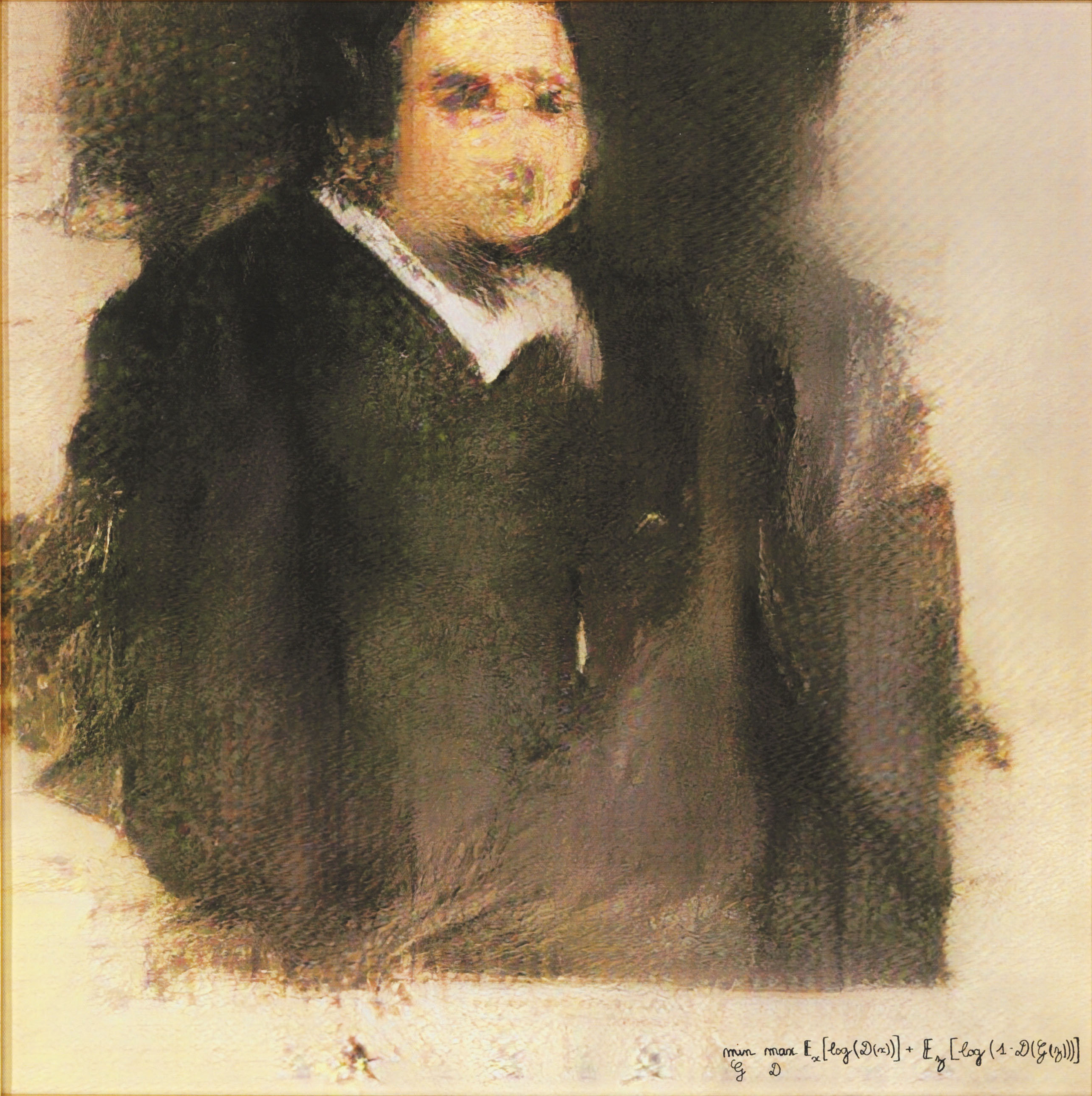
Parallel to these technological advances, AI art entered the art market. A prominent example is Edmond de Belamy — an AI-generated painting created in 2018 by the artist collective Obvious and auctioned at Christie’s for USD 432,500. This spectacular sale marked the first time an AI artwork had been offered by a major auction house and sparked global attention regarding AI’s potential in the arts. Since then, much has happened: AI art festivals (such as the AI Biennale since 2022) and media-art events like Ars Electronica have integrated AI works. In 2019, the first humanoid robot artist — Ai-Da — was introduced to the public; Ai-Da independently paints portraits using cameras and a robotic arm. In 2023, Amsterdam opened the first AI art gallery dedicated exclusively to AI-generated works. For late 2025, Los Angeles is set to open DATALAND — the world’s first museum for AI art. These developments demonstrate that AI art has grown from a niche into an established part of the global art scene.
What Types of AI Art Have Emerged So Far?
AI art is diverse and can be classified into several categories based on the role AI plays in the creative process. The main types include:
Generative AI Art
This is the most well-known form, where the AI functions as a generator. Here, AI-generated artworks emerge nearly autonomously from algorithms, often based on short text or image inputs. Examples include the text-to-image systems Midjourney, DALL·E, or the open-source model Stable Diffusion, which can create images from descriptions alone. Generative AI art is essentially an evolution of traditional generative art — but instead of purely random algorithms, it relies on machine-learning models.
Similar generative approaches exist for other media: AI systems can compose music, create poetry, or even continue unfinished works — for instance, attempts have been made to complete Beethoven’s unfinished 10th Symphony using AI. Generative AI can produce entirely new visual forms that a human alone might not conceive. However, these models still operate based on learned data, raising the question of whether the creation is truly “new” or simply recombined.
Interactive AI Art
In this category, AI does not primarily generate images but guides interactions or analyzes the viewer. The AI becomes part of the artwork in real time. There are installations that react to audiences through facial recognition — for example, “Smile to Vote,” which attempted to estimate a person’s political preference based on their expression. Another example is “Smart Hans,” an installation in which AI tries to guess the number a person is thinking of using pattern recognition.
Here, AI is used to create a dynamic, interactive experience — the artwork changes through the viewer’s participation or data. Interactive AI art often overlaps with media art and performance, involving sensors, technology, and AI algorithms. Importantly, no new media object is generated; instead, AI acts as a mediator between human and artwork. This form raises questions about human–machine communication, surveillance, and the ethics of data use.
AI-Assisted Art
In this form, the creative lead remains with the human, while AI serves as a tool or source of inspiration. Many artists use AI to support their work without giving up full control. Examples include style transfer, where AI repaints an image in the style of another, or AI-enhanced image processing such as DeepDream, which adds psychedelic patterns to existing works.
In such cases, art is created with AI — the AI helps experiment with variations or generate ideas quickly. The artist might let AI create many drafts and then refine or reinterpret the most compelling ones. AI thus influences the outcome without autonomously creating the artwork. This category also includes collaborative projects where humans and AI co-create. At the extreme end are systems that partially assume authorship — such as the decentralized autonomous artist Botto, which generates works independently and auctions them via smart contracts.
Overall, AI-assisted creativity includes everything that supports the artistic process without replacing it. For many traditional artists, this is the preferred approach: AI as an amplifier of human creativity.
Which AI Tools Currently Shape Artistic Production and Creation?
In recent years, a wide range of AI tools for artistic work has emerged. Some of the most widely used systems and platforms for creating AI-generated artworks include:
Midjourney – Artistic Text-to-Image Generation Midjourney is an independent AI image-generation platform operated through a browser-based chat interface. Known for its highly artistic, visually rich outputs, it is used by many designers and illustrators to create concept art and stylized imagery. As a text-based image generator (users enter a description and receive an image), it often produces painterly, detailed compositions. Thanks to its active community and accessible workflow, Midjourney has played a significant role in the widespread adoption of AI-generated imagery.
Midjourney
FLUX (Black Forest Labs) – Multimodal Image Generation & Editing: FLUX.1 Kontext is a multimodal model capable of understanding both text and image inputs. It allows users to supply reference photos to maintain the same character or object consistently across multiple scenes — a standout feature. Even with just one reference image, FLUX can place the same character into new contexts without losing identity. It also excels at rendering text within images and supports context-aware local editing (e.g., changing colors or adding objects) without disrupting the rest of the image.
Black Forest Labs
Google Nano Banana (Flash 2.5) – Precision Editing & Inpainting: Nano Banana is the codename for Google’s internal image model, now publicly confirmed as part of Gemini 2.5 Flash Image. It was designed specifically to solve one of the biggest weaknesses of earlier image generators: edit consistency. Nano Banana performs precise inpainting and local modifications without distorting unrelated areas of the image. A Google Cloud developer described it as “built from the ground up to solve consistency issues” — meaning requests like “make the shirt blue” no longer create extra fingers or broken backgrounds. Faces, proportions, and environments remain stable while the requested change is applied.
Gemini
Runway ML – Pioneering Text-to-Video Creation: Runway ML is one of the pioneers of text-to-video generation. Gen-2, launched in early 2023, was among the first models to let users create short video clips (a few seconds long) purely from text prompts. Built on diffusion models, Gen-2 evolved from Gen-1 (video-to-video stylization) into full video generation. It supports both text-to-video and image-to-video, producing videos typically 4–8 seconds long at resolutions up to ~1280×720 or 768p.
Runway ML
LUMA Dream Machine – Text-to-Video with 3D & Physics Understanding: Luma AI — known for its 3D capture and NeRF technology — introduced Dream Machine, a text/image-to-video tool powered by its Ray3 model. Dream Machine produces ~5-second videos (currently ~1360×752 px) from text or image prompts. A key differentiator is its spatial reasoning and physics consistency: Luma highlights that Ray3 can “think visually and represent logical sequences of action,” including realistic physics and stable motion. Dream Machine offers smoother camera movements and object motion than many competitors and is the first generative video model with native 16-bit HDR color, enabling professional-grade color work. Luma also supports multi-shot storytelling: the model can create several connected scenes with consistent characters, style, and atmosphere — similar to ByteDance’s Seedance — allowing small narrative sequences to be generated in one pass. Dream Machine is available via iOS app and web interface.
LUMA Dream Machine
Kling (Kuaishou) – High-End Chinese Text-to-Video: Kling AI, developed by Kuaishou (a major competitor to ByteDance/TikTok), is a high-end generative video model that has quickly gained traction: over 10 million videos have been created since launch. It supports both text-to-video and image-to-video and offers “cinema-grade” motion quality. Kling provides several model versions up to Kling 2.5 Turbo, runs cloud-based (accessible via platforms like fal.ai and pollo.ai), and supports HD output up to 1080p.
Kling
Google Veo (DeepMind) – Next-Generation Video AI with Audio & Physics: Veo is Google DeepMind’s newest video AI model. Announced in May 2024 and now in version 3, it sets new standards in realism and functionality. Veo is a text-to-video model that also accepts image inputs and — uniquely — generates audio alongside video. Veo 3 can synthesize matching sound effects, environmental noises, and even dialogue. Veo maintains character, lighting, and scene consistency across cuts. It also understands camera terminology (e.g., close-up, tracking shot) and supports lip-synced speech. Veo is integrated into Google’s Gemini product ecosystem.
Google Veo Veo in Flow
Udio – AI Music Generation for Songs & Soundscapes: Udio transforms simple text prompts into full songs — including instrumental arrangement and vocal performance with lyrics. The standout feature is musical quality: users frequently report that Udio outperforms competitors in melody creation and instrumental realism. One user notes: “Melody-wise nothing can compete with UDIO.” Another adds: “Udio kills it for instrumentals.”
Udio also provides multitrack stems, enabling producers to export individual drums, bass, vocals, etc. Users can upload their own audio and let Udio extend or reinterpret it — instrumental or with vocals. This makes Udio attractive for both musicians and sound designers.
Udio
ElevenLabs – State-of-the-Art AI Voice Synthesis: ElevenLabs is one of the most advanced text-to-speech and voice-generation platforms. Its standout strength is the realism and expressiveness of its voices — often considered indistinguishable from human speech. It produces highly realistic and versatile voiceovers in over 30 languages and offers a library of more than 3,000 community-contributed voices.
Another defining feature is voice cloning (VoiceLab): users can clone their own voice with just a few seconds of audio or create brand-new voice identities. ElevenLabs supports fast “instant cloning” as well as a more advanced mode requiring longer recordings for maximum authenticity. It has become well known for replicating the voices of real individuals with “frightening accuracy.”
ElevenLabs