Simulacra, Simulation and Hyperreality in the AI Art of Visual Generative Art
Jean Baudrillard’s theory of Simulacra and Simulation explores the relationship between reality and signs in modern society. He defines simulacra as “copies that represent things which never existed, or no longer have an original,” and simulation as “the imitation of a real process.” In mass media, Baudrillard sees an alienation from reality: signs and images “exist only for themselves,” without any connection to a tangible world. Hyperreality is thus “the image of something that does not exist in reality, but is instead its own simulacrum.” In other words: a model-generated reality in which fiction and reality become indistinguishable.
Read more
12 25
Jean Baudrillard’s Theoretical Model Simulacra and Simulation (1981)
In a world increasingly shaped by digital media and artificial intelligence, the question of what constitutes reality must be reconsidered. Where does the real begin, and where does simulation take over? With his work Simulacra and Simulation (1981), the French philosopher Jean Baudrillard introduced a theoretical model that describes these very shifts.
Read more
11 25
The Renaissance of Surrealism Through AI
A warm summer evening in Berlin: in a small gallery, visitors gather around an image that looks as if it came straight from a dream. But instead of oil and canvas, it is an algorithm at work. Where Salvador Dalí once melted his clocks, an artificial intelligence has now hallucinated a desert landscape with liquefying clocks and floating fish—generated in seconds by a simple text prompt.
Read more
11 25
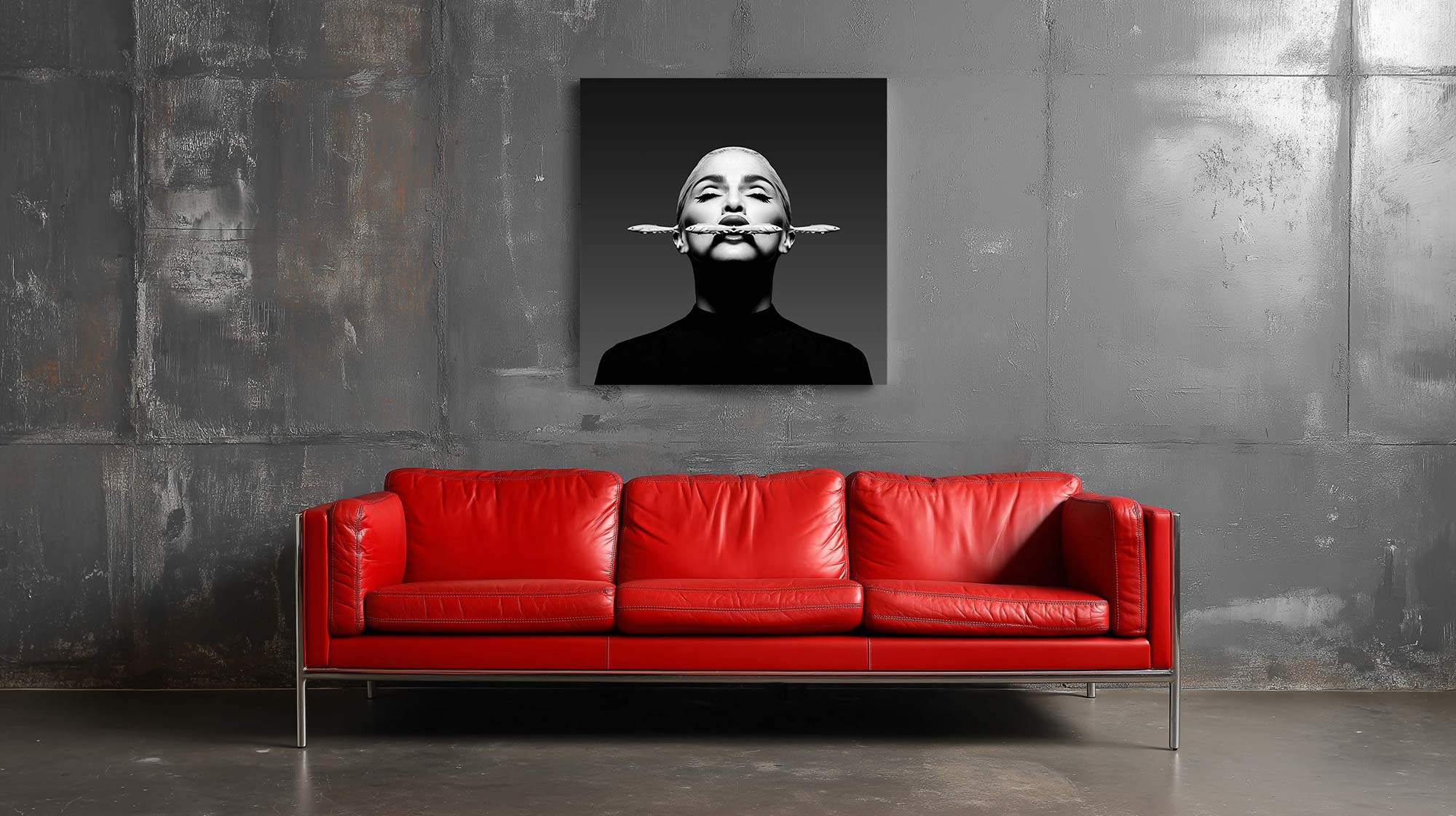
Art Reveals Its True Power Only in the Right Environment
A single image is not enough—art unfolds its full impact only when placed in the right environment. Whether at home, in the office or in a museum: art truly resonates when space, light and context align.
Studies show that the same artwork can be perceived completely differently depending on its surroundings. In museums, viewers react more emotionally, perceive colors as more vivid and remember what they have seen for longer. Art can have tangible effects in private or professional spaces as well—it calms, inspires and even enhances focus. Curators and interior designers have long understood this: a painting appears different on a colored wall than on a white one. Lighting can highlight details or make them disappear. Even the frame, the distance to furniture or the height at which a piece is hung can significantly shape its impact.
For my own works, I create complete environments in Midjourney to stage each motif intentionally. Each artwork is “mapped” into its surrounding space so that piece and environment become one—creating an effect that lasts.
Conclusion: An artwork is more than its motif. It needs space, light and atmosphere—in short: the right context. Only then does art begin to speak.
09 25
Forms of Digital Art
AI Art
AI art refers to artworks that are created or influenced through artificial intelligence. AI models such as artificial neural networks are used to generate images, music, text or other artistic forms. Essentially, any artwork that is not created directly by a human but produced by an AI system can be classified as AI art.
Read more
Immersive Art
Immersive art aims to transcend the traditional role of the viewer: the visitor does not merely observe the artwork but becomes part of it—spatially, visually, acoustically and sometimes interactively. Common methods include large-scale projections, light installations, sound environments, virtual or augmented reality (VR/AR), sensors and interactive control systems. The goal is to blur the boundaries between subject and space, creating a holistic sensory experience in which one becomes part of the artwork itself.
Read more
Digital Art
Digital art refers to artistic works created using digital technologies or presented within digital environments. It encompasses a wide range of expressive forms—from computer-generated images to video and sound works, all the way to interactive and immersive installations.
Read more