Simulacra, Simulation and Hyperreality in the AI Art of Visual Generative Art
Dirk Habenschaden / ChatGPT, Dec 2025
What lies behind Baudrillard’s theory of Simulacra and Simulation
Jean Baudrillard’s theory of Simulacra and Simulation examines the relationship between reality and signs in modern society. He defines simulacra as “copies that depict things which never existed, or no longer have an original,” and simulation as “the imitation of a real process.” In mass media, Baudrillard identifies a profound alienation from reality: signs and images “exist only for themselves,” detached from any tangible world. Hyperreality is thus “the representation of something that does not exist in reality, but is instead its own simulacrum”—a model-generated reality in which fiction and reality become indistinguishable.
These theoretical concepts can be directly applied to the current AI-based art series: Sirene | eat — pray — love, Dance with the Devil, the unwanted touch and Poetry in Black and White. Each of these bodies of work plays with simulation, hyperreality and signs: they emerge in a dialogue between human imagination and machine algorithmics, constantly questioning where the real ends and the simulated begins. What follows is an interpretation of each series through Baudrillard’s lens
Sirene | eat — pray — love
Sirene | eat — pray — love: The Surreal Distortion of the Familiar
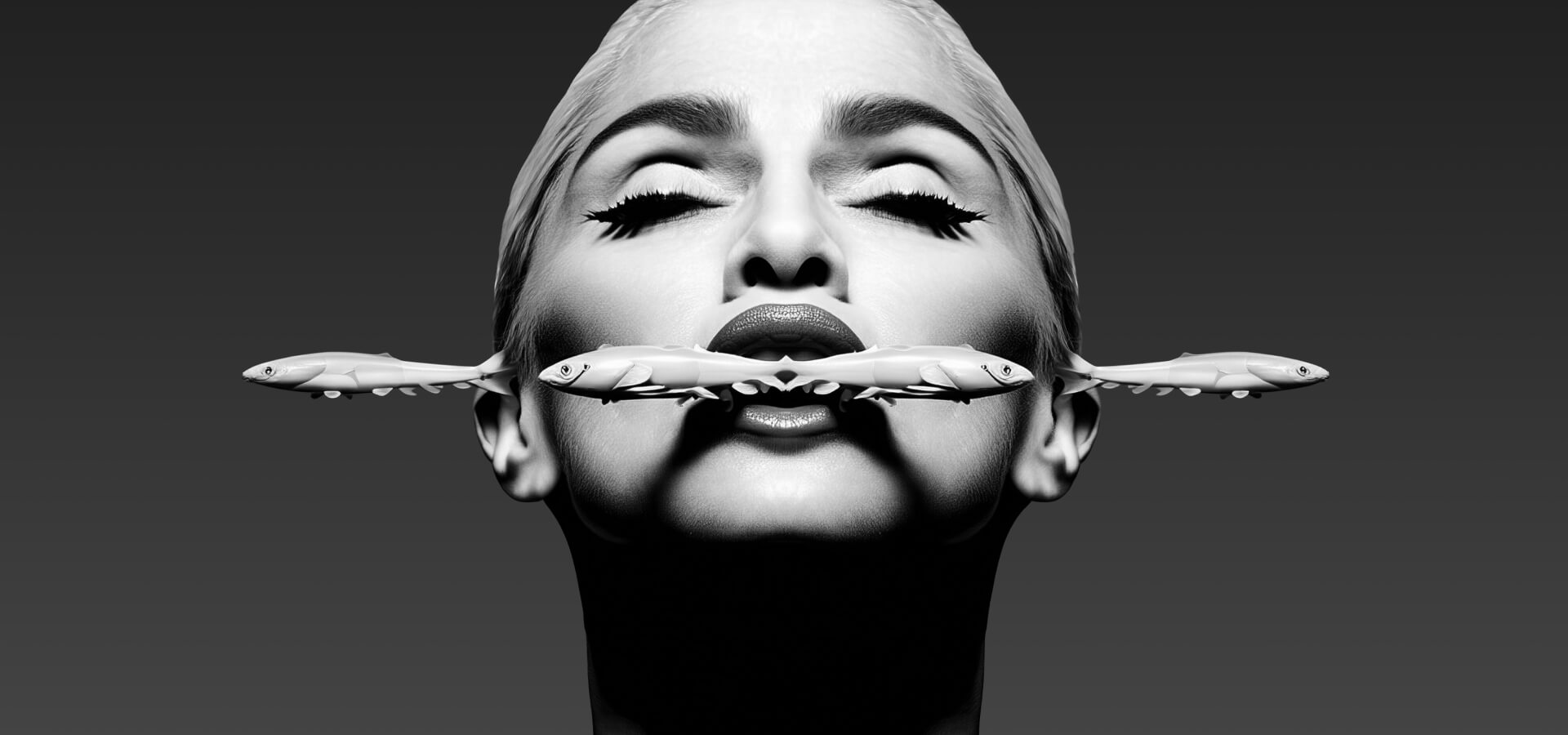
Sirene is a series of graphic-surreal black-and-white female portraits exploring the allure and depth of the hidden. At first glance, the images resemble classical portraits—yet “alien elements lend the faces a subtle surreal quality that shifts perception and estranges the familiar.” In these works, “imagination and form meet” in precise stillness: real facial structures merge with dreamlike, intangible details. The portrayed women exist only within the artificial visual world. Generated by neural networks—“when neural nets dream”—they have no real-world counterparts. We are thus literally looking at simulacra in Baudrillard’s sense: “copies of people who never existed.”
The beauty of the surface seduces until the hidden reveals itself and reality begins to waver.
Because the faces appear convincing yet belong to no real individuals, a hyperreal effect arises: the portrait feels truthful but is ultimately a mirage. The viewer loses themselves in “forms, textures and subtle transitions,” unable to distinguish what is real from what is fictional. Sirene exemplifies the second order of Baudrillard’s image regime—a distorted representation of reality so perfected that it starts to overwrite the real itself. The result is a quiet, seductive hyperreality where photographic illusion is as present as the reality it mimics.
Dance with the Devil — Nine facets. One act of resistance.
Dance with the Devil: Humanity Caught in the Web of Signs
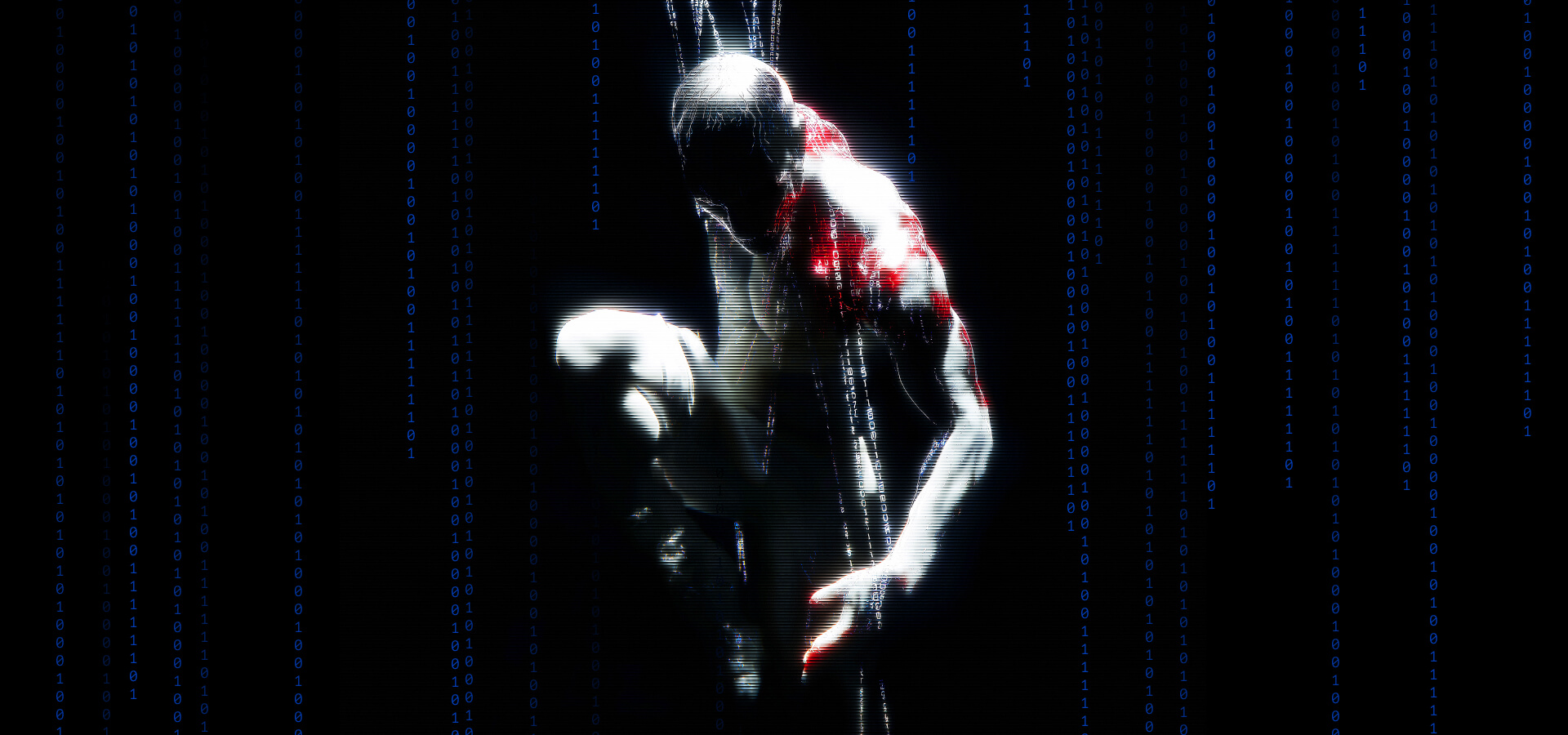
Dance with the Devil is a multimedia artwork explicitly reflecting on humanity in an age of technological control. The series asks provocatively: “What remains when humanity becomes a variable?” —when humans appear only as interchangeable data points within a system. Visually, this is staged through nine motifs showing human bodies in a tense field between submission and defiance. The figures are “trapped in a web of binary structures, covered by signs that both obscure and reveal.”
Here, digital code literally overlays the body: endless sequences of 0s and 1s veil the human silhouette, rendering the figure machine-readable while stripping away individuality. Baudrillard’s idea of a reality replaced by data appears here with striking clarity: nothing escapes measurement; everything becomes a dataset. In the accompanying poetic texts, even emotions exist only “as data sets—stored, readable, copyable.” This total mapping of the human points to a hyperreality of absolute control in which signs (code) dominate and suppress lived reality.
Humanity as an anomaly inside the perfect system
Despite its dystopian vision, Dance with the Devil allows a spark of resistance to shine through. From the cold blue cascades of algorithmic light emerges a glowing red—“the last ember of resistance,” the final living impulse that resists full simulation. This red symbolizes the unpredictable, unmeasurable essence of the human soul—something that “cannot be deleted, reset to factory settings, or purchased.”
Interestingly, the series dissolves the boundary between physical artwork and digital space. Every image contains a unique Vibrant Response Code, a gateway into an expanded reality. Scanning the code opens a digital resonance field behind the print: binary verses become audible, accompanied by sound and motion. Image, sound and text merge into an immersive experience that transcends the surface.
The artwork thus exists twice—once as a material print and again as a virtual occurrence—embodying a genuine hyperreality experience. The signs in the image generate their own sensory world without referring to any traditional external reality. Baudrillard’s prophecy of all-encompassing simulation is both enacted and critically reflected here.
the unwanted touch — Anatomie einer übergriffigen Gesellschaft
the unwanted touch: A Visible Metaphor for the Invisible
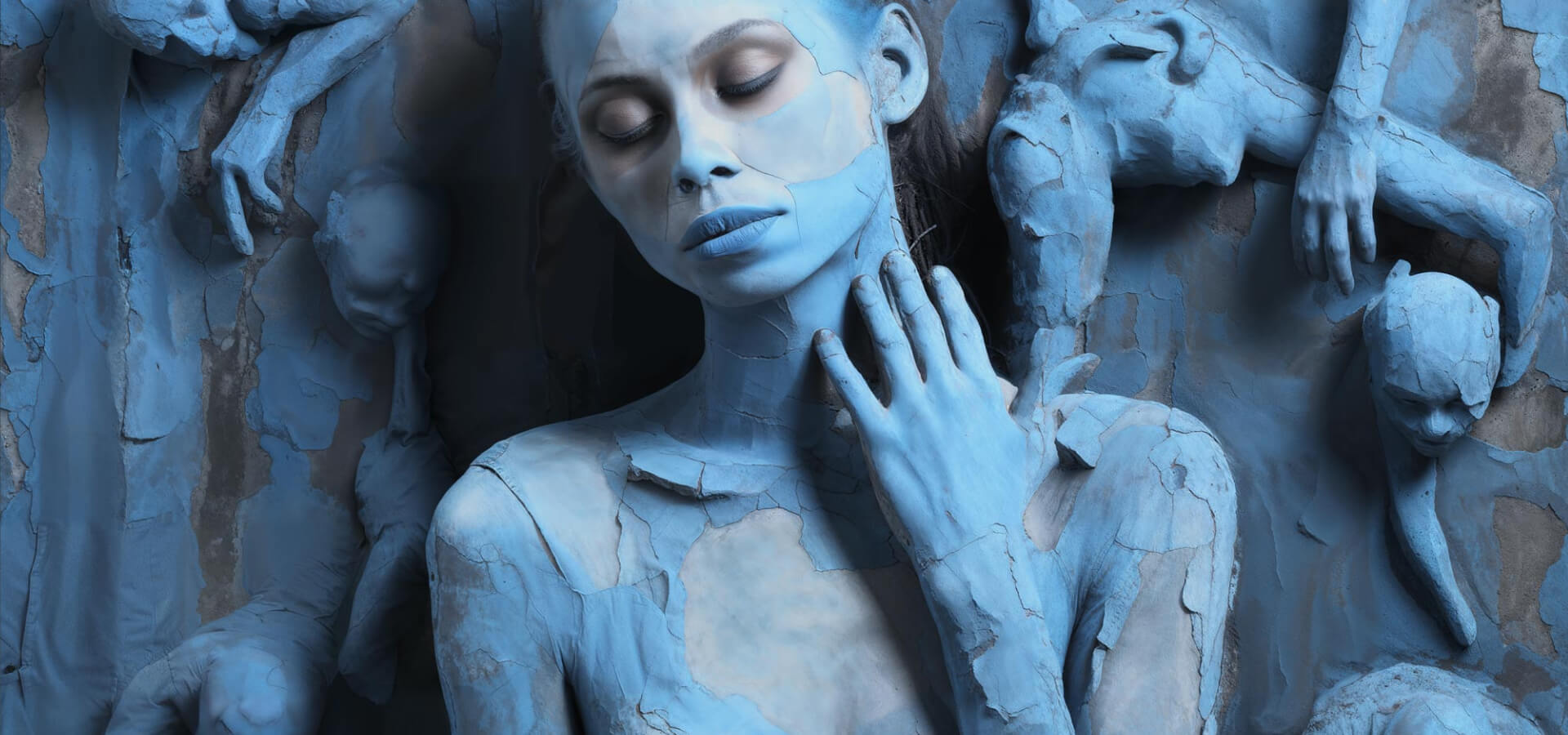
The series the unwanted touch translates a deeply real subject—the trauma of social boundary violation—into a symbolic visual language. It begins with the moment an unwanted touch crosses a person’s boundary and becomes a psychological invasion. The series visualizes the invisible emotional wounds resulting from such acts by depicting a permanent defense mechanism: the affected person develops “a symbolic armor,” a protective crust guarding their violated integrity. This hardened shell—a second skin—eventually stiffens and becomes a visible metaphor for internal rigidity, “expressing shame, disgust and self-protection.”
When language fails, the image begins to speak.
From Baudrillard’s perspective, the unwanted touch creates a simulacrum of trauma. Emotional pain is invisible and individual—but in the artwork, it appears as a concrete, graspable sign: the armored skin covering the entire body. The artwork shows not physical injury, but the idea of psychological damage embodied in physical form. Hyperreality emerges through exaggeration and externalization of the invisible: the encrusted figure appears hyperreal in its painful detail, even though it represents only a symbol. By rendering the inner state as an outward shell, the series starkly demonstrates how signs and reality can merge. The sign (the crust) becomes the bearer of truth about the invisible—it effectively creates its own referent in order to convey the unspeakable. Thus, the unwanted touch shows how simulation in art can evoke empathy for real human experience: the hyperrealism of the depiction—unsettling as it may be—allows us to feel the scale of the trauma even though we know the armored body is not literally real.
Poetry in Black and White: AI Beings and Multidimensional Hyperreality
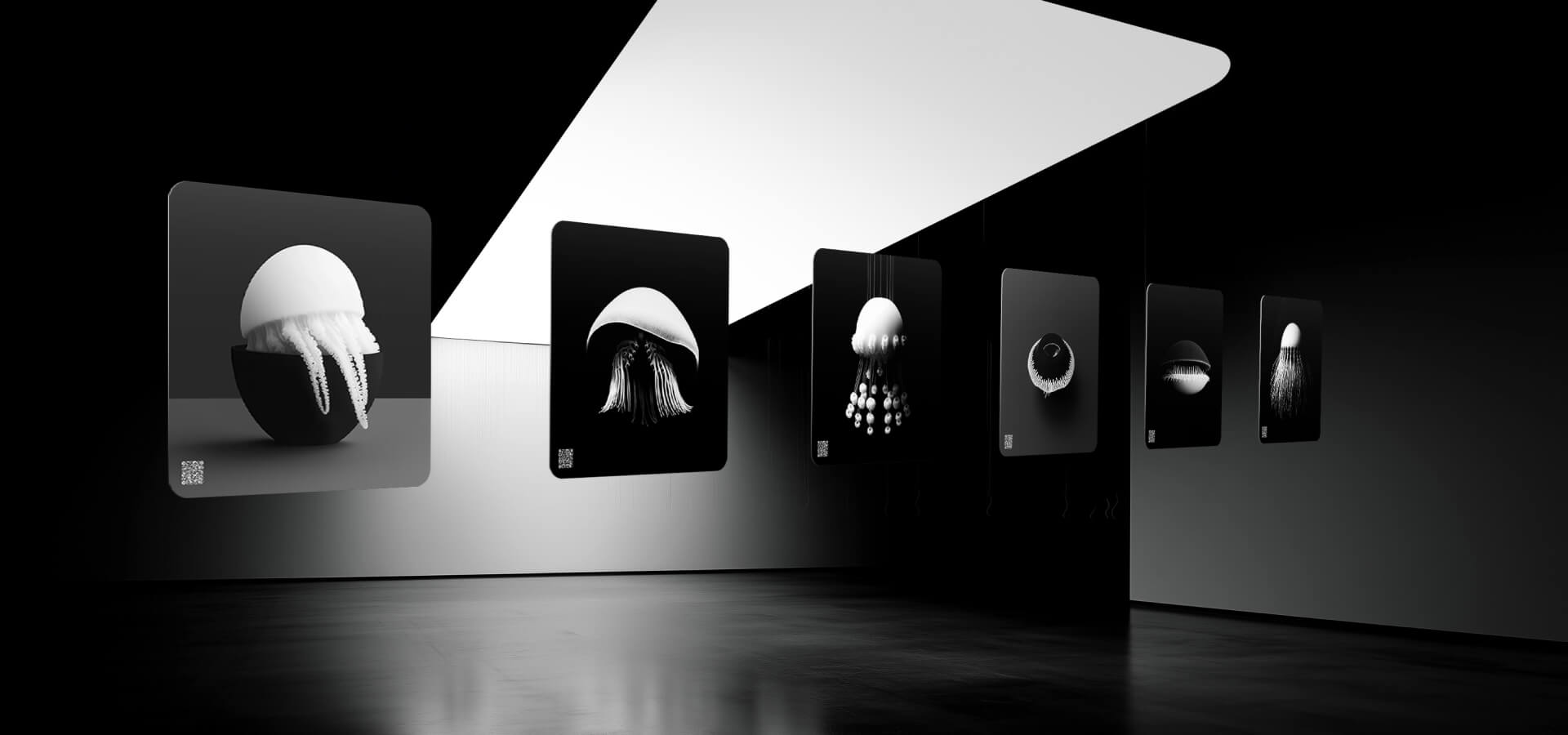
Poetry in Black and White transcends the boundaries of the single image and creates an entire multimedia universe of artificial beings. The series revolves around six “artificially created entities,” gradually discovered “through a quiet dialogue between human imagination and the precise logic of the machine.” These creatures exist exclusively within the artwork: digital mythical beings, born from algorithms and curated by the artist, with no equivalent in the natural world. In Baudrillard’s terms, they are simulacra—fabricated signs without a natural original, forming a reality of their own.
What is particularly remarkable is how Poetry in Black and White allows viewers to enter the living world of these simulated beings. Each of the six motifs is equipped with a so-called Vibrant Response Code—the heart of the project, transforming each image into a “multidimensional experience.” Behind the rigorously composed black-and-white prints lie layers of sound, voice, and interaction: “sound collages that grant each being its own acoustic presence; spoken poetry that renders the invisible audible; and a digital vitality that responds to movement and touch.” In other words: each image continues to live beyond its surface. “Every work is more than a picture: a fragment of a larger being, a moment within a flowing system waiting to be discovered.” The viewer is invited “to see, hear and feel what lies beyond the visible surface.” The series thus creates a unique hyperreality: the boundary between the static artwork and a dynamic virtual world dissolves completely.
Simulation becomes tangible—not as deception, but as possibility.
In Baudrillard’s terminology, Poetry in Black and White marks the transition into the fourth order of simulation: the simulacrum permeates every layer of experience. The beings in the series have no external reference—they are fully real within their own artificial world. At the same time, they possess a perceivable presence for the viewer: their qualities are experienced through image, sound and interaction, almost as if they were truly living entities. This “more real than real” sensation corresponds precisely to Baudrillard’s description of hyperreality—a state in which models of something (in this case, of living beings) feel so real that the absence of a physical original becomes irrelevant.
Yet what is especially interesting is that Poetry in Black and White does not depict simulation as a threatening loss of reality but as a poetic enrichment. By making the invisible movements and narratives of these AI beings audible and tangible, the series creates new layers of meaning beyond the visible signs. Here, technology becomes a medium to make human imagination sensorially experienceable—simulation turns into a creative act that expands our perceptual reality rather than merely deceiving it.
Conclusion: Between Code and Emotion — Art in the Age of the Hyperreal
The four series demonstrate how AI art can explore and make tangible the ideas of simulacrum and simulation. Each creates its own variation of hyperreality:
Sirene subtly distorts portraiture, turning realistic faces into dreamlike signs without originals.
Dance with the Devil envisions a dystopia in which humanity dissolves into data and algorithms—yet clings to the “untouchable,” a final ember of emotion resisting simulation.
the unwanted touch uses the power of visual signs to represent invisible pain, showing that a simulacrum can be both startlingly artificial and deeply truthful.
Poetry in Black and White dissolves the boundary between viewer and artwork, integrating them into an immersive network of images, sound and interaction—where new beings become real through our attention and imagination.
Together, these works reveal that we truly inhabit an age of binary control and simulated signs—yet they also highlight the human ability to wrest meaning from this condition. The art of Visual Generative Art demonstrates what Baudrillard described theoretically: “the relationships between reality, symbols and society” in a world where boundaries blur. Rather than despairing over the death of authenticity, these series invite us to explore new layers of reality. They show that simulation in art doesn’t need to signify alienation—it can open a deeper dimension of experience, a space where code and emotion meet and the unimaginable takes form.
In the interplay with the unreal, the profoundly human emerges—whether in a gaze that expresses hope despite all algorithms, or in a digital being we encounter with empathy. The simulated images thus become mirrors through which we can rediscover our own reality.